
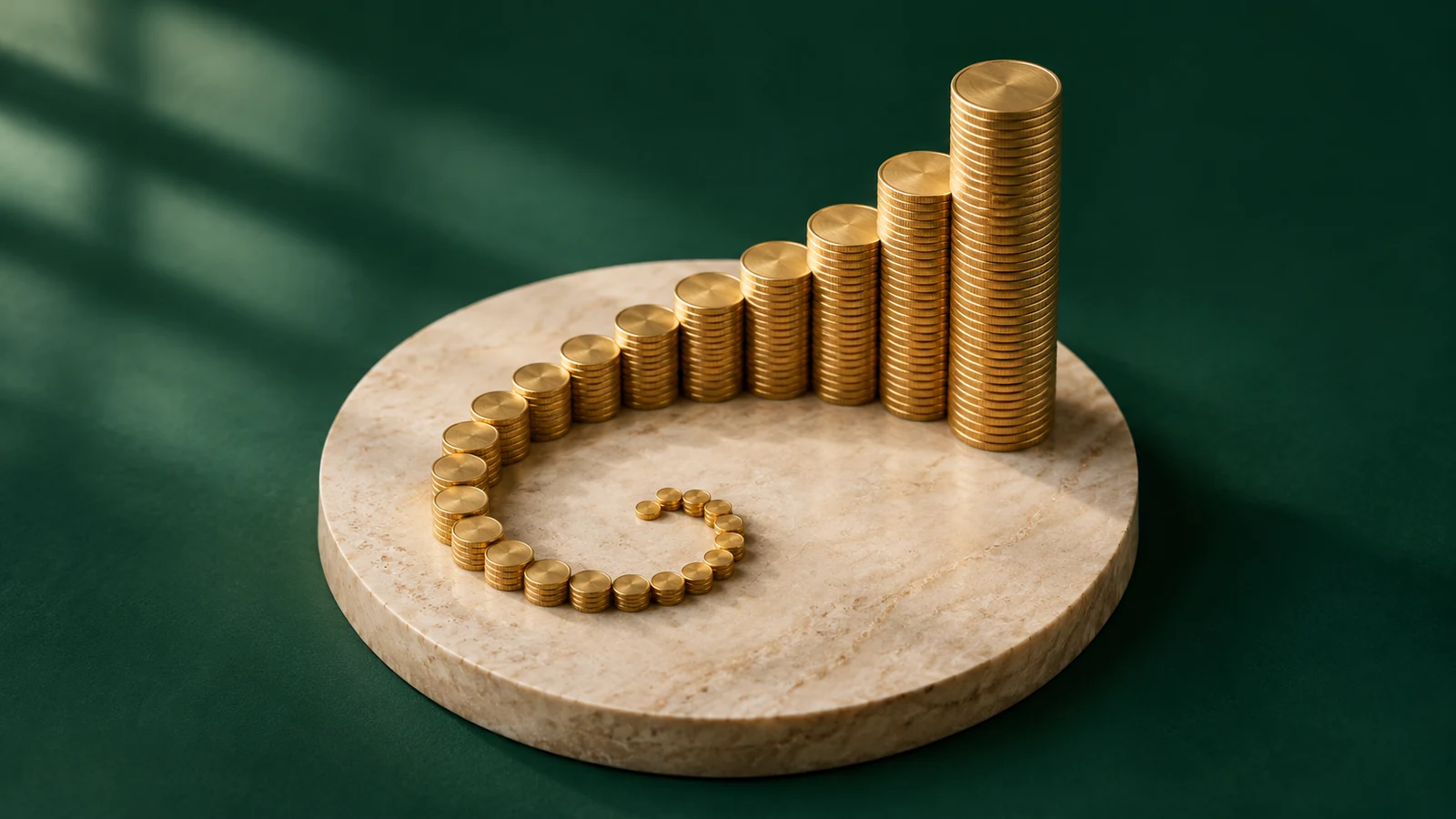
In short: Compound interest is interest earned on your original money plus the interest it has already earned, so growth builds on itself. The US Consumer Financial Protection Bureau defines it in those terms. The longer it runs, the faster the total grows, which is why time often matters more than the amount you begin with.
The difference between simple and compound
Simple interest pays only on your original sum, so it grows in a straight line. Compound interest pays on the running total, so it curves upward. The gap looks trivial for a few years and then becomes the largest part of the result.
Take $10,000 earning 7% a year, with nothing added. This is our own arithmetic, and the rate is an assumption chosen for illustration, not a forecast of what any investment will return.
| After | Simple interest | Compound interest |
|---|---|---|
| 10 years | $17,000 | $19,672 |
| 20 years | $24,000 | $38,697 |
| 30 years | $31,000 | $76,123 |
By year 30, compounding has produced more than twice the simple interest total. Note also how the increases accelerate: the first decade adds about $9,700, while the third adds about $37,400 at the same rate.
Time beats size, up to a point
Starting early matters because the earliest dollars have the longest to grow. Consider three savers below, each earning an assumed 7% with monthly contributions. These figures are also our own calculation.
| Saver | Monthly amount | Years | Total contributed | Ending value |
|---|---|---|---|---|
| Starts at 25 | $300 | 40 | $144,000 | About $787,000 |
| Starts at 35 | $300 | 30 | $108,000 | About $366,000 |
| Starts at 45 | $600 | 20 | $144,000 | About $313,000 |
The first and third savers put in the same $144,000, yet the early starter finishes with about two and a half times as much. Compounding is not magic, however, and this table flatters no one in particular. Most returns are not smooth, and a saver who starts late can still accomplish a great deal by contributing more. Starting late is a reason to begin, and not a reason to give up.
Three things that change the result
The rate. Small differences in return compound into large differences in outcome, which also applies in reverse to fees. A fund that charges one extra percentage point a year gives up a surprising share of its final value, as shown in index funds for beginners.
Frequency. Interest credited daily or monthly grows slightly faster than interest credited annually. This matters less than people expect at normal savings rates. When comparing savings accounts, the annual percentage yield already takes it into account.
Interruption. Compounding depends on leaving the money in place. Withdrawing during a downturn, or cashing out a retirement account when changing jobs, removes the base on which future growth would have been earned. This is often the most expensive mistake of all, as our guide on how to start investing explains.
To run the numbers on your own savings, try our compound interest calculator.
The Rule of 72
For a rough estimate, divide 72 by the annual rate of return to find how many years it takes money to double. At 6%, doubling takes about 12 years. At 9%, about 8. The result is an approximation and works best at moderate rates, but it is handy for mental math.
The rule can also be turned on inflation. At 3% inflation, prices double in about 24 years, which is why cash left idle for decades steadily loses buying power. For precise figures with your own numbers, the US Securities and Exchange Commission offers a free compound interest calculator.
The same math works against you
Debt compounds too, and usually at a higher rate than savings earn. Unpaid credit card interest gets added to the balance, then charged interest of its own. At 21.19%, the Federal Reserve’s average rate on credit card accounts in the third quarter of 2026, the Rule of 72 suggests a balance left untouched would double in under three and a half years, before any fees.
For that reason, clearing expensive debt usually comes first, since it gives you a return no ordinary investment can reliably match. See the debt snowball vs avalanche comparison for ways to do that.
Why it is harder than it looks
The trouble with compounding is psychological. Human intuition tends to project in straight lines, so people commonly underestimate exponential growth. Researchers have a name for this: exponential growth bias. The early years also offer little feedback, since a small balance earns small amounts, and the dramatic part of the curve comes decades later.
The practical answer is to automate your contributions and judge your progress over years rather than months. This is one of the reasons why good personal finance basics rely more on setup than on repeated acts of resolve.
Frequently asked questions
Does compound interest apply to stocks?
Strictly speaking, stocks do not pay interest. They can compound in a similar way, however, when you reinvest dividends and when gains build on earlier gains. Returns vary widely from year to year and can be negative, so the smooth curves in calculators are a simplification. Treat them as illustrations of the principle.
How often should interest compound to make a real difference?
Less often than marketing suggests. On a $10,000 deposit at 4%, the difference between annual and daily compounding is about $8 in the first year by our calculation. Comparing the annual percentage yield between accounts is usually enough, since the rate itself matters far more than how often it is credited.
Is it too late to benefit if I start at 50?
No. A 50-year-old may have 15 years until retirement and perhaps 20 or more after it, with money still invested during that time. Larger contributions compensate for part of the lost time, and in the US, people aged 50 and over can make extra catch-up contributions to retirement accounts.
What is the formula for compound interest?
The standard formula is A = P(1 + r/n)^(nt), where P is the starting sum, r the annual rate, n the number of compounding periods per year and t the number of years. In practice, a spreadsheet or online calculator is easier and allows for regular contributions as well.
